


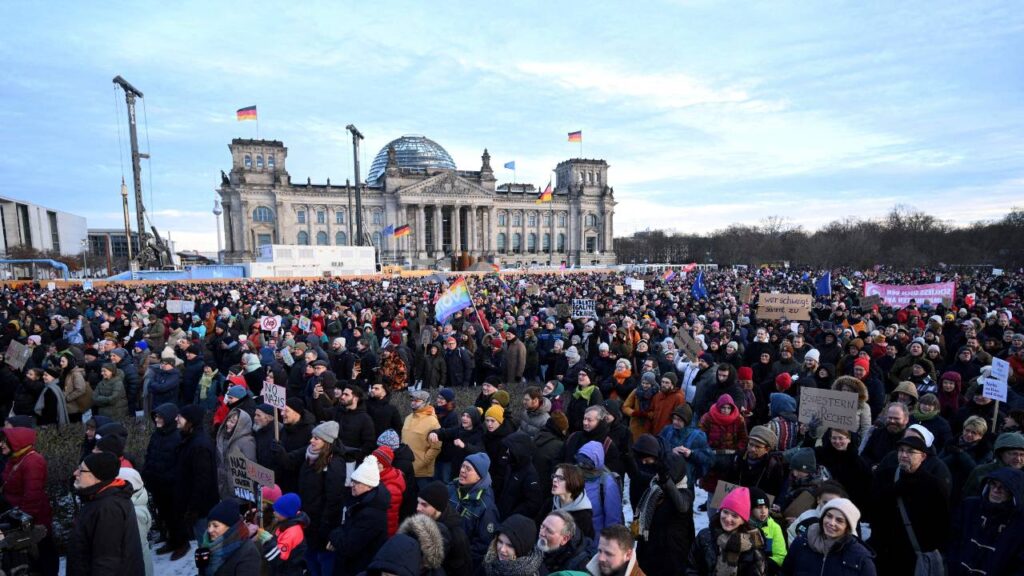
Germany’s Political Shift: Conservatives Lead, Far-Right Gains Strength
Berlin – A Political Earthquake in German Elections
Germany’s latest exit polls have sent shockwaves through the political landscape, with Friedrich Merz’s conservative Christian Democratic Union (CDU/CSU) taking the lead, while the far-right Alternative for Germany (AfD) secures its strongest postwar showing. The preliminary results indicate a major shift in voter sentiment, setting the stage for a politically complex and potentially divisive future.
According to early projections, the CDU/CSU has secured approximately 30-32% of the vote, marking a significant comeback after their 2021 defeat. Meanwhile, the far-right AfD has surged to an unprecedented 18-20%, solidifying its position as Germany’s second-largest party for the first time. The ruling Social Democratic Party (SPD), led by Chancellor Olaf Scholz, is struggling at around 17-19%, reflecting growing dissatisfaction with the government’s policies.
The results indicate a historic shift in Germany’s postwar political order, as voters respond to pressing issues such as economic instability, immigration policies, and energy crises.
CDU/CSU’s Comeback: Merz’s Conservatives Regain Strength
For Friedrich Merz and the center-right CDU/CSU alliance, these election results mark a remarkable turnaround. After their 2021 defeat and subsequent struggles, the conservatives have capitalized on public discontent with the current government’s handling of inflation, energy prices, and border policies.
Merz, a vocal critic of Scholz’s leadership, focused his campaign on restoring economic stability, tightening immigration laws, and bolstering Germany’s international standing. His pro-business stance and emphasis on security appear to have resonated with voters, particularly in Bavaria, Saxony, and Baden-Württemberg—regions traditionally leaning towards the CDU/CSU.
With these results, the CDU/CSU is now in a strong position to negotiate coalition agreements. However, forming a stable government will require delicate political maneuvering, especially in light of the AfD’s growing influence.
AfD’s Unprecedented Rise: A Challenge to the Political Establishment
The biggest political story of the election is the Alternative for Germany’s (AfD) historic performance. Once considered a fringe movement, the far-right party has now firmly positioned itself as Germany’s second-most powerful political force.
Why Has AfD Gained Ground?
- Immigration Backlash: Many voters are frustrated with liberal immigration policies, which they perceive as a burden on public services and national security.
- Economic Concerns: Rising energy prices, inflation, and job insecurity have fueled anger towards the ruling coalition.
- Disillusionment with Traditional Parties: Growing dissatisfaction with mainstream political parties has driven many voters toward populist alternatives.
- Regional Strongholds: AfD has seen overwhelming support in East Germany, where economic disparities and skepticism of Berlin’s policies remain high.
While the AfD’s rise is alarming for many in Germany’s political elite, the party remains highly controversial. Its anti-EU stance, nationalist rhetoric, and hardline immigration policies make it an unlikely coalition partner for mainstream parties.
SPD’s Struggles: Scholz’s Government Loses Favor
For Chancellor Olaf Scholz and the Social Democrats (SPD), these results are a major setback. The SPD’s 17-19% performance represents a stark decline from the 25.7% they secured in the 2021 elections.
Scholz’s government, a coalition with the Greens and Free Democrats (FDP), has faced relentless criticism over its handling of economic policies, energy shortages, and defense strategies. Despite efforts to position himself as a stabilizing force, Scholz’s approval ratings have steadily declined amid growing public dissatisfaction.
Key Reasons for SPD’s Poor Performance:
- Economic Challenges: High inflation and rising energy costs have eroded public trust in the government.
- Coalition Tensions: Infighting between the SPD, Greens, and FDP has hindered decisive policymaking.
- Weak Leadership Perception: Scholz has struggled to project strong leadership, particularly in contrast to Merz’s assertive campaign.
With these results, the SPD now faces serious questions about its future leadership and whether it can rebuild public trust before the next election cycle.
Coalition Scenarios: What Comes Next?
Given the election results, Germany now faces complex coalition negotiations. Some potential government formations include:
1. CDU/CSU + FDP (Center-Right Coalition)
- Pros: Would align on economic policies, tax reforms, and pro-business strategies.
- Cons: The FDP’s poor showing may weaken its influence in negotiations.
2. CDU/CSU + Greens (Unlikely Alliance)
- Pros: Could balance conservative economic policies with environmental commitments.
- Cons: Major ideological differences, particularly on climate policy and social issues.
3. SPD + Greens + FDP (Continuing the Traffic Light Coalition)
- Pros: Maintains political stability, avoiding a dramatic shift to the right.
- Cons: Unpopular among voters, as all three parties suffered setbacks in this election.
4. CDU/CSU + AfD (Highly Controversial and Unlikely)
- This remains politically toxic due to AfD’s extreme positions and rejection by mainstream conservatives.
Most analysts predict that Merz’s CDU/CSU will take the lead in coalition negotiations, but forming a stable government will be a challenging process.
European Reactions: A Warning Sign for the EU?
Germany’s election results have also sparked reactions across Europe, with many seeing the AfD’s rise as part of a broader trend of right-wing populism gaining momentum.
Key International Reactions:
- France: Concerns over Germany’s political shift affecting EU policies on migration and economic stability.
- Brussels: The EU is watching closely, as a stronger AfD could mean greater resistance to European integration.
- United States: A CDU-led government is expected to maintain strong transatlantic ties, but an AfD surge could complicate diplomatic relations.
The election outcome could reshape Germany’s role in Europe, especially on issues like defense, trade, and climate policies.
Conclusion: A Defining Moment for Germany
Germany’s 2025 election exit polls have highlighted a major political transformation. With CDU/CSU leading, the AfD’s historic gains, and SPD’s struggles, the coming weeks will determine the future direction of Europe’s largest economy.
Friedrich Merz emerges as a strong contender to shape the next government, but coalition talks will be crucial in defining how Germany navigates economic challenges, immigration policies, and international relations.
As Germany enters a new political era, one question remains: Will traditional parties find a way to govern effectively, or is the far-right’s influence set to reshape the country’s future?